Categories
Memoir Writing

That Time I Didn’t Have a Concussion

On February 18, I learn that if you have an open head wound, there’s no waiting at the ER. They make sure you’re in a wheelchair and take you right back to a room. Before seven stitches close the gash above my left eye, and before an x-ray confirms my shoulder fracture, a doctor tells me I have a mild concussion. I twist my face into a disdainful smile. What an idiot, I think.

The next day, when I overhear my husband telling a friend that I am concussed, he gets the same ugly smirk. Bah! I think. Why can’t he get his facts straight?

After my fall, I am propped up on pillows on the couch, doing that miserable calculation between pain management and side effects. Sleep is elusive and brief. On day three, I announce to Brad that the grand collie hasn’t been walked for six hours. While he’s out with her, I remember that, in fact, middle son took her not that long ago.

When he comes back, I apologize. I completely forgot Westy took her!  Then comes an ugly moment of recognition, followed by a confession.  Oh my god—I think I had a concussion!

Yeah, I think you did. This man of mine looks at me with such kind patience. He unhooks the collie from her harness and starts dinner.  I get up from the couch and wince, tugging my sling around my elbow.

In the kitchen I ask, Was I daffy that day, when you got home?

Yup. You told the same stories over and over. You’ve been pretty goofy.

Weston, who sat in the ER with me for hours, joins us and adds, Mom, you told me like ten times to go get some lunch. And you were really, really happy to see every single person who came in the room. I mean, even more than your usual personality.

A few days later, a half-moon of pain appears inside my forehead, a pulsing white headache that extends backwards through my skull. I am, once again, simply amazed. On bright days, I wear sunglasses inside. I close my eyes and become curious about the shapes of my headaches, how the half-moon becomes a crescent or sometimes splits into two purple lights. Over zoom, my doctor tells me that concussions need time and rest. She tells me not to go back to my normal activities and to limit screen time. No more one-handed loading of the dishwasher so I can feel at least minimally useful. No more binging Love is Blind on my iPad as the meds smooth down some of my bone pain. And no writing for week after long week.
Categories
Memoir

Snow Flowers

Off the corner of 28th and Race, I am on my knees, watching small circles of brilliant red bloom onto a patch of snow. I’m dizzy, afraid I might throw up. I stop moving and watch the crimson drip, drip, drip.

A voice behind me. Are you okay?  I see the blue uniform of our mail carrier, a friendly man I’ve chatted with before. Burly, with a beard and ruddy cheeks, he looks especially tall from the ground. He came around the corner just as I fell–my right hand extended to hold sweet Micki’s leash. My left arm now hangs useless. That shoulder is an iron band of electrified pain. I am, more than anything else, amazed.

No, I’m not okay. I’m hurt.

Patrick, the mail carrier, stands in front of me now, his phone in one hand, Micki’s leash in the other. My friend’s sweet husky mix is excited to meet another human. Patrick says, Cuts on the head can really bleed a lot. I’ve shifted onto my behind, and cold slush seeps into my blue corduroys. I pull a kleenex out of my ski jacket pocket and hold it above my left eye. It comes away soaked, carrying the smells of rusted iron and old rivers, of steel mill smoke and sweet tea. Dots the color of my mother’s front yard tulips land on my sleeve.

I just want to go home. I just want to rewind five steps and stop looking up at the bluebird sky, turn back time and put my attention on my feet.

As Patrick waits with me, a stranger calls from across the street. Are you okay? Do you need help?

A few minutes later, Micki and I are in his car. His is the face of compassion. Mid-thirties and clean-shaven, he pales when he glances over at my cut. I direct him to my house. My shoulder is so fucked, I tell him, probably more than once. His name is Mike, and he makes sure my son is home to take me to the hospital. He says he doesn’t care if I get a little blood on his car’s pristine white interior. Patrick will tell me later where Mike lives. I still owe him a thank you note.

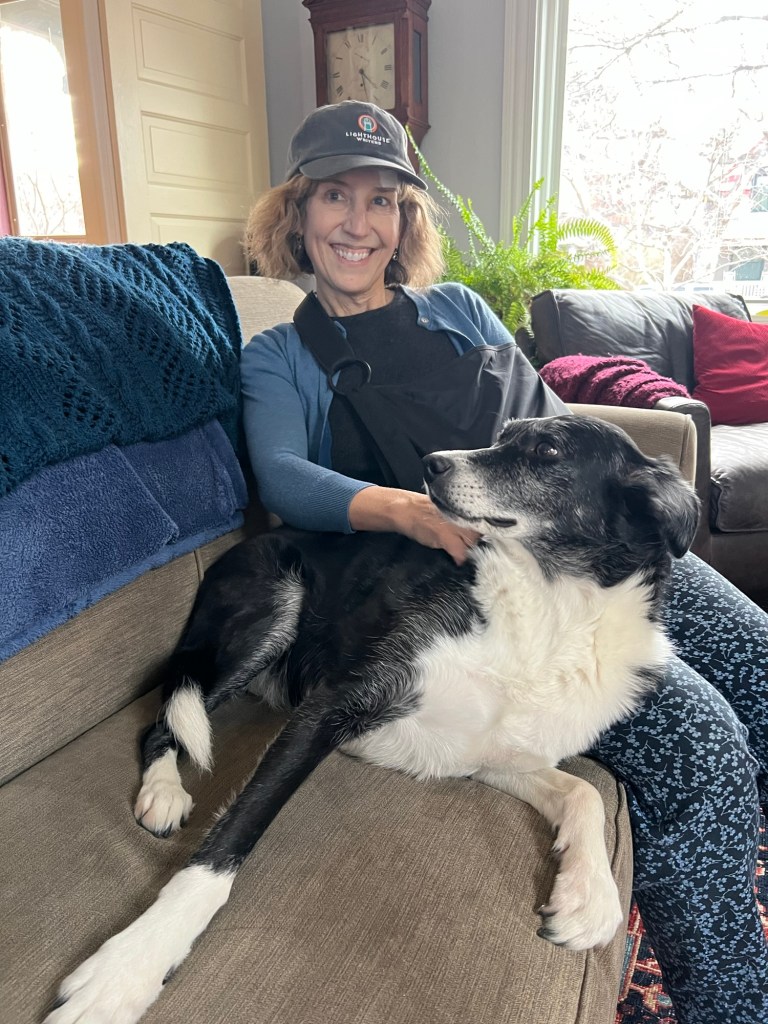
Good collie medicine!
Categories
Memoir mental health

Summer, 2024

Five of us sit at a round table in a back corner of The Shed, a Santa Fe restaurant with low roof timbers and art on every wall. To my right is my youngest son’s girlfriend, Felicia. Her chin-length brown hair is pulled back in a clip, her long dancer’s legs crossed under the table. Across from her is Weston, my middle son. At thirty, he looks much like his father did when we met, with the same long ponytail and those bright blue eyes. Tom, our youngest and tallest, is often mistaken for Max, who is seven years his senior. They have matching dark eyebrows and smiles that light up a whole room. 

I have started calling this four-day August road trip the “foodcation.”  We have laughed our way through heaping plates of enchiladas smothered in chili sauce and told story after story over chocolate cake and caramel flan.

“Tom,” I say, “Remember when we came here for Thanksgiving, and you couldn’t walk back to the hotel because you were so full?” 

“How could I forget?  You almost killed me making me move around after that buffet!”  We recall the perils faced by youngest brothers who refuse to surrender during eating contests.    

Brad says, “We have some bad memories here, too.”

“Hey,” I respond, “let’s not talk about those sad times.”  Felicia hasn’t heard the Santa Fe chapter of Max’s mental health saga, and part of me is afraid that she will be horrified. Another part of me wants to avoid the belly-clenching fear this story invokes, a fright that has lived inside me like a restless tenant. 

Tom asks, “What happened? I don’t really remember.”  He was only eleven then.  I sigh and look across the room at a landscape painting that conveys the sheltering feel of this high valley surrounded by mountains. Captured in a simple frame are the taupe and green, the unexpected flashes of gold, that animate this part of New Mexico.

“It’s okay,” Brad reassures me and rests his warm hand on my shoulder.  “When Max was eighteen,” he explains, “we dropped him off at college here.”

“It was his dream school,” I add.  “He was so happy when he got accepted. We shielded you from a lot of the details.” I look over at my youngest, who lives half a country away.  “After we dropped Max off, he stayed in his dorm room for two days. Then, when a Resident Assistant checked in with him, he told him that he wasn’t safe. That night, the RA drove north, and we drove south. We met halfway, in the middle of the night, to get him home.”

Weston remarks, “Sounds like a pretty incredible RA.”

“He was.” And I see Max’s pale face as he stepped out of that stranger’s car at a rest stop near Trinidad.  My son’s despairing silence on that three-hour drive lands once again on my chest.  “I don’t know what we were thinking dropping him off at school when he was so depressed.”  A wave of remorse washes over me at the depth of my denial then. I pretended that a little bit of Lithium and a fancy college would make Max well, that his depression would magically give way to the brilliant future we had all expected for him.

I put my dessert spoon down and feel around inside myself for the shame I carried at failing to keep Max safe. My mind holds a clear wish that I had been wiser in those years.  Yet, glancing at the faces of my family, the regret is met by clear, bright gratitude. Max is in Denver today, going to work, building skateboard community, taking care of the dogs.  

Brad has filled in more details of the Santa Fe saga.  “A few weeks after we brought him home, we had to come back and get the rest of his stuff.”   

“Oh, yeah, I forgot that part.”  Our smiles to one another are rueful.

“Tom, remember you were carpooling with Carolyn that fall?  She told me that when she asked you how Max was doing, all you said was that he was really sad.” 

“I don’t remember telling her that, just coming home from school and he was still on that futon couch.”

Weston looks at his baby brother. “Yeah. He was on that couch for a long, long time.”

I nod. “I would go to work and worry about him, but coming home was even harder. I felt like I could help my counseling clients more than I could help my own kid.”  I take a deep breath, switch gears.  “And then he bounced back like a rubber ball, not sleeping, never happier, like his mood grew wings.”

We are all laughing now.

            Dessert plates cleared, we wait for the check. Weston says, “This was cathartic. I’m glad we talked about it.”

            “Me, too,” I respond.  “I guess sometimes the past just gets to be the past.”

Categories
humor Memoir Writing

That Damn Mustard

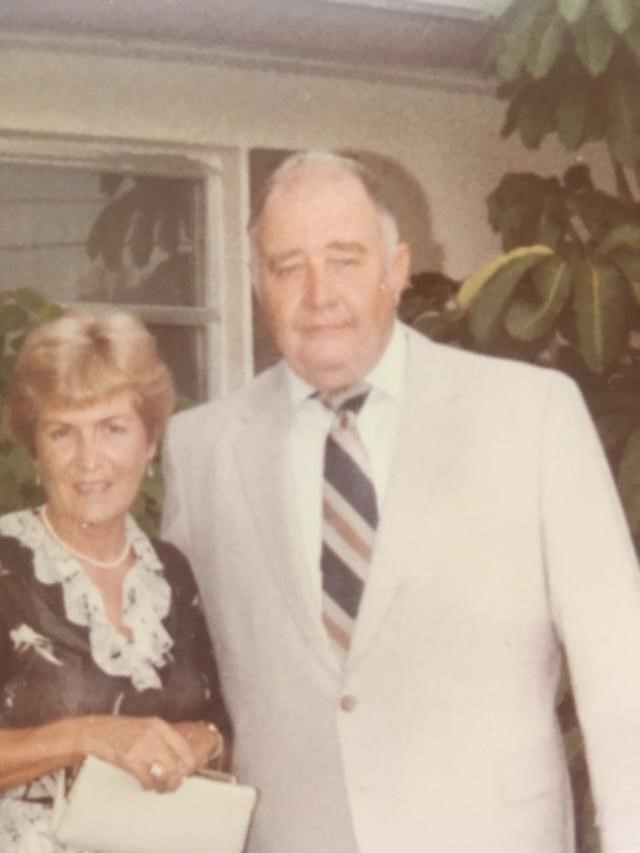
Whenever I write about my dad, who died almost ten years ago, at 91, I feel happy. He had a big heart and a brilliant wit. Of course, as my sister likes to say, our folks didn’t read all those fancy parenting books, but even writing about hard times, I appreciate finding my father on the page. He always reminds me to take pleasure in words, in food, and in family.

I want to tell you about the mustard. I wandered outside on a break from the book and looked around for a stone to add to the marker where his ashes are.  How my father’s ashes ended up buried here by the Fairplay cabin, and not in Iceland as he had wished, is not the mustard story. Why I place stones when I go see that spot is also a different story. I will, however, tell you this, loosely related to mustard, which was his favorite condiment. My father loved going to church, and this place felt like church to us. Both of us used to cry when we sang hymns, maybe out of relief. (God does love a sinner, I’ve heard, because we tend to be more interesting people.) Dad also loved old drinking songs: “How Dry I Am” and “In Heaven there is No Beer” were two favorites that he might sing to wind up a night at the campfire.

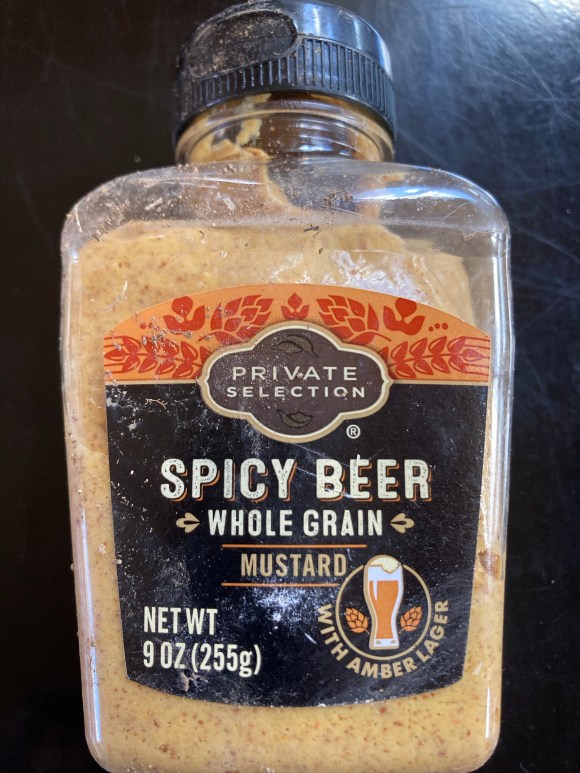
This morning, hunting around for the right stone, I came across a plastic bottle of mustard next to the fire pit. It’s Safeway brand: spicy beer whole grain mustard. Dad loved our neighborhood Safeway, and whenever I go there, I put in the old phone number he gave them twenty years ago so we could get our discount.  It always makes me smile. The Safeway mustard is peppery, like my dad could be. And it’s got lager in it. He preferred Stroh’s, but now and then, he could really enjoy a fancy beer.

Before the cabin got walls and a roof, my parents would visit from Florida and sit outside with my husband and our boys. Dad demonstrated the fine art of making his wife laugh, and soon, my husband took up the habit. This has been one of my dad’s most lasting gifts.

Today I picked up this mustard that one of our sons left out a couple of nights ago. Dad would be glad I didn’t even think of throwing it away. I carried it with me to the little bench by his ashes and his stones and said Hi Dad! Like I always do. And I said I miss you, which I don’t always do.

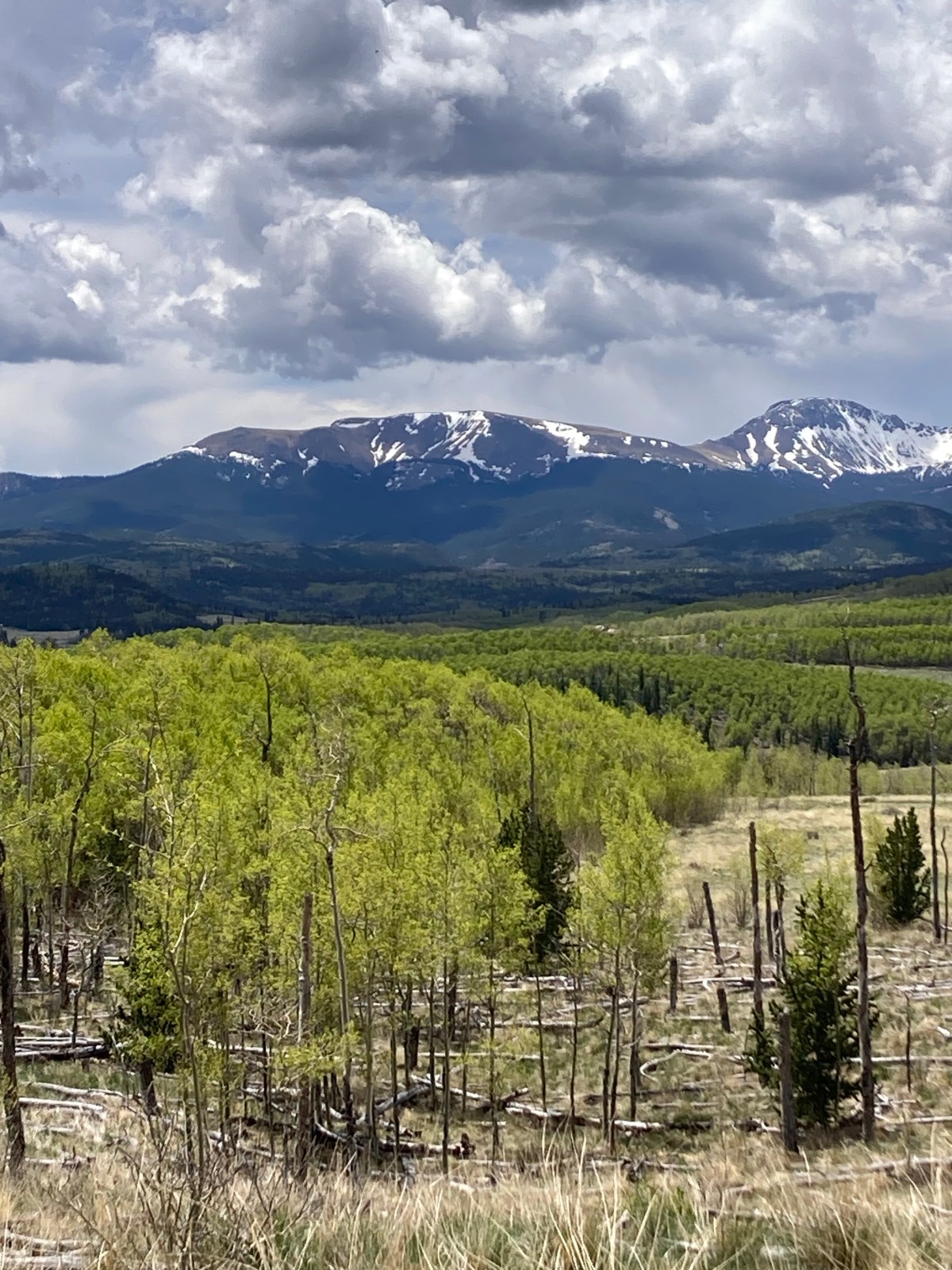
Then out of nowhere—and I mean nowhere, because I’m grateful for his long life and his peaceful death and wherever he is now; this is a man who drank (almost) all the beer he wanted and danced (almost) all the dances he could. He had a good, good life, and a long one. Still, out of nowhere, I said, I wish you were here, I wish you would come back!  And I burst out crying. I don’t usually cry hard anymore. I really have no reason. This morning, though, when I stood there with that mustard in my hand, I was just a little girl wanting to put her head on her daddy’s shoulder one more time. I sat on the bench for a while, and I’m telling you, the meadow was beautiful like I’ve never seen it, the kind of green in the new aspen leaves and in the sprouts of grass that can only happen after a month of rain.

I know there’s nothing special about my grief, how I walk around in middle age without parents and with four sisters instead of five. I know that when I was in my forties, the friends who scooted ahead of me into the beyond, the counseling clients who tried and tried but just couldn’t make it–I know all those funerals and tears were warmup for the privilege of getting older and missing more people. I know Junes can just be like this. And I’m perfectly all right.

Categories
Memoir mental health

Dunedin Part 3

The Light and The Dark

On the eightieth or ninetieth or hundredth day of my mother’s hospitalization, in the fall of 1980, I sit in the chancel of St Andrew’s Presbyterian Church, wearing a youth choir robe. Palm trees sway outside the sanctuary windows. I feel like a soft-limbed robot, and whatever I sing with the other altos, I sing with fear in my throat. I don’t know the word “sepsis” or that my father and oldest sister in Washington have been told to prepare themselves for Mamma’s death. I do know about fear. I know about having been bad, and about wanting another chance to be good.

On that morning, as I try to pray, my thoughts are shards of porcelain, sharp behind my eyes. Then, all at once, a bright warm light comes into my mind and lifts me out of broken thoughts. The light surrounds me, telling me without words that I will be all right, that I don’t have to be afraid. Warmth moves from the top of my head to the tips of my toes. This lifting up and calming down happens in an instant.

It could be that this exact light extends from my mind and heart and body to the mind and heart and body of my mother. Maybe you believe in something like this light, or in coincidence, or in a traumatized girl having a delusion. At different times in my life, I consider all of these. What matters is this: on that Sunday morning, my mother wakes up asking for food, for someone to please wash her hair. Instead of dying that day, she begins her recovery. And as soon as she is strong enough, my father brings her home to us in Dunedin.

Maybe because she is so skinny and pale, her eye sockets huge, that my mother seems to glow with life, to look at Florida and each of us with wonder. A snapshot of her in a wicker chair on my Aunt Barbara’s porch shows her with bony arms akimbo and legs crossed under a draping skirt. Her face is turned sideways, her cheekbones shadowed.

As her step steadies and her eyes soften, the mechanical in me recedes. I settle into her presence and into her touch. She smooths the hair from my face when I worry at night. I feel her hand and I feel her warm arm like a shawl around my shoulders.

One night, in the moist air of early winter, my parents dress for a party, he in a white shirt and dinner jacket, she in a rayon dress and low-heeled sandals. As they get into the car, my father hands my mother a cocktail. She looks down into the plastic cup filled with vodka and 7up and raises it—unsmiling–to her lips.

Panic lifts me from wherever I am standing to a view of the drink from just outside and above the car. What must that moment have been for my mother?  I imagine her having held those months of sobriety like an anchor rope growing heavier every day, until she had no choice but to let it go. 

Once again, she sits alone in front of the television for hour after hour. And once again, I start sitting with her, determined to help. On random nights, she drink-talks to me about her father not letting her go to college, because education is wasted on girls. Her voice slurs telling me how terrible it is to depend on a man: Never be stuck like I am! And tears streak her mascara into half-circles under her eyes.

Trying to save her from the shadows becomes my own night-time compulsion. I listen to her, and I shush her. I help her to bed and pull a sheet up to her chin as she tells me how sweet I am, how much she loves me. Rescuing her is my penitent duty, a chance to make up for every cigarette I ever stole from her, every lie I ever told, and every time I hated her. Like the hangovers and blackouts she must have suffered, I feel the after-effects of self-martyrdom like a slow, blistering burn. I am exhausted and increasingly confused. How, when she gets up the next day, can she not thank me for taking care of her?  I redouble my efforts to help and be good, to distract myself from the accumulating darkness of my resentment.

Categories
Memoir mental health

Dunedin, Part Two

Must Remind Myself

Wild parakeets land between the heavy oval leaves of Nanny’s grapefruit tree, the tree whose strong branches hold late winter fruit full of bitter juice and sharp, white seeds. “Oh, the parakeets were pretty,” she tells me in her husky voice, “Florida is such a special place!” The flock of birds with gleaming green heads and pale under bellies, chattering away in pairs as they rested and preened, produced a combined mini-roar like nothing Nanny has heard before. I never see the parakeets, only feel the joy of their flight as she describes it to me.

The most alive place in Nanny’s house is her Florida room, with three walls of Jaoulosie windows in rectangular aluminum frames. Against the west-facing wall is a wooden table where Nanny sets down her orange juice, her pastry plate, or her cup of coffee, clearing space amid a shifting clutter of drawing pencils and paint tubes.  Alone, she often spends the day painting, delighting in the bright plumage of migrating cardinals or blue jays as she re-creates in oil and canvass a perfect Indiana Dunes sunset or a bouquet of pink carnations.

 A long, padded bench is heaped with pillows that I would curl around when I was four, when Mamma and I extended a winter visit that seemed to stretch forever into a long horizon of calm. Nanny’s house overflows with a gentle messiness. Each surface has a small stack of books, a “Cornerstone” magazine or “Reader’s Digest”. Her Bible sits on a table by her easy chair, across from the TV where she watches Jim Neighbors sing on the Laurence Welk show. She has an old-fashioned record player and opera albums.  To her, stereo speakers are a modern marvel.

Nanny is 85 and a widow ten years when my sister and I arrive at her house to start high school, in 1980. Twin beds in the guest room are covered in green polyester spreads. When we open the closet to hang up our ironed jeans, our shirts and church clothes, we are greeted by the smell of mothballs. Nanny’s kitchen is narrow and shadowed, its counters littered with rye breadcrumbs, the fridge stuffed with small plates of leftovers, with jars of rhubarb jelly and mold-frosted applesauce. There are none of my mother’s scrubbed surfaces, her bustling cleanliness, no windowsills filled with carefully tended cuttings. My sister and I bring our arguments, sometimes whispered, sometimes not. We slam doors without thinking, and we take long, hot showers that fill Nanny’s small bathroom with smoky steam on ninety-degree days.  We burst the seams of her small house with the expanding uncertainty of our lives.

In 1980 I am in Dunedin, but not happy, there but not there. Listening to Nanny’s story about the parakeets, yearn for her serene appreciation of Florida, and I want to believe in my own innocence again. The two or three weeks we expect to wait for our parents to come to Florida and move with us into our new house stretch to a month, to six weeks, to eight. We move over to Aunt Barbara’s house on San Mateo, where we use a different set of beds, push our clothes into another closet. The backyard here is overgrown with lush fronds tended by Uncle Jerry, whose feet are calloused from walking barefoot whenever possible. My uncle is working on a translation of poems from Spanish into English. His typewriter sits facing the screened in front porch and the small, rust colored car he calls the “Wankle,” where he leaves his car keys so he can always find them when he needs them.

Years later, I learn that our mother developed sepsis that fall, that our sister and father were told to prepare themselves for her death. At fourteen, I only know that our mother’s voice has become a faint whisper. For many days, she has not been able to talk on the phone with us at all. Day after day her strength recedes as a tide might that can never fill its former pools.

At Nanny’s house, at Aunt Barbara’s house, I keep a green notebook. I don’t write about my mother or the precariousness of our family. Summer entries are about kissing boys and smoking pot, about trying to not be mean to my nephews. The addresses of two friends from Junior High are scribbled in childish block letters, oozing with sincere plans to write, to stay in touch, to be a better person, at last. One September entry, I start to write “Aug,” but disappear it with three very hard, dark lines. Amid a jumble of fragments is this: “Everything will work out. Must remind myself.” My pen presses hard into the paper. I am trying to make the writing look good, look legible and even.

Then, crossed out in black ink, and later lined over in red, is the address where I could send letters to the hospital:  Mamma (temp) 201 23rd St., Wash DC 20027.

After that, I mostly write prayers, no dated entries for a long time.

Categories
Memoir

Dunedin, Part One

San Jose Circle

Just south of Palm Harbor, on Alternate 19, a two-lane highway running along Florida’s central Gulf Coast, a sign features a cheerful Scotsman wearing a kilt and holding a bagpipe.  “Welcome to Dunedin: Delightfully Different,” it reads. As a small child, in the early 70’s, this town where my grandmother and great-aunts lived filled me with wonder. When I was fourteen—uprooted and deeply afraid—I arrived there with my older sister to start high school while my mother languished in a hospital up north. My sense of wonder had been displaced by the slow creep of understanding: I might never see her again.

The youngest in a combined family of seven, I was both spoiled and anxious. I could often forget the unpredictable violence that punctuated my early life.  In a world where children are at the mercy of their parents, and where mercy exists, Dunedin’s San Jose Circle– a traffic ring fringed with swaying palms and fuzzy-needled evergreens–became my compass.

On childhood visits to Dunedin, I rode in the way-back of a loaded station wagon as my father drove south from our home just outside Washington, DC, away from winter and to this small Florida town known for oranges and pelicans and old people. Daddy turned left from Alternate 19 onto a wide street paved with red brick. As car tires thrummed over the rough surface, our mother gazed out the window, then looked back at us and smiled. Spanish Moss dripped from the boughs of trees like living tinsel, and a warm breeze carried the scent of orange concentrate from a citrus grove and nearby processing plant.

Daddy navigated slowly around the arc of San Jose Circle. A solitary wooden bench faced west, where the afternoon sun angled over the water of St. Joseph Sound. East of the circle was an elementary school, and directly south, a small pond where raucous ducks clamored for pieces of stale bread. Daddy turned left, pointing us north, then parked in the driveway of my Nanny’s house. When she came out to greet us, she opened her arms wide, her face aglow. She smelled of fresh-baked bread she had waiting to slice for us.

After dinner, we would walk to the end of San Jose Street for sunset. Across St. Joseph’s sound, shadows lengthened the tips of mangroves edging Caladesi Island, the protective strip of land between Dunedin and the open Gulf. I waded in chill December shallows next to old wooden pilings and sank my toes in low-tide muck. When the salt breeze turned cold, I snuggled in between my parents and basked in the gentle raspiness of Nanny’s voice as she pointed out a pelican flying close to the water or marveled at the close of another beautiful day.

On sunny winter mornings, my great Aunt Ruth watched me place pennies on the railroad track behind her house on Douglas Avenue, just a block from Nanny. I’d wait with my hands pressed over my ears for the train to rumble past, feeling the ground shake under my feet. Sometimes a muscled arm waved from the conductor’s window, and a friendly smile shone out for this blonde little girl and the elderly woman standing with her. After the caboose went by, Aunt Ruth, lean and straight where Nanny was round and soft, helped me search for the flattened copper ovals I would later show my big sisters.

Aunt Ruth lived with her own big sister, Dora, called DoDo, an oddly childish nick name for someone who seemed to me old beyond time. On late morning visits, as we filled their small house, I sat on a wooden stool that exuded a faint and friendly scent of dust. I drank sweet, fresh orange juice that Aunt Ruth poured for me into a jam jar. After the grown-ups finished their coffee and talking, Aunt Dora would play a hymn on the slightly out of tune upright piano that she had only recently learned to play. She answered our applause with a girlish smile to each of us in turn.

Over the following decade, two of my father’s sisters also moved to Dunedin, adding points of contact to San Jose Circle. The winter I was fourteen, my father decided to sell our house in Washington and move our family south, too. My mother’s lover–her best friend, Michael—was dead. The basement bedroom he rented from our family sat empty and cold. Before my father typed his resignation letter at the kitchen table, he had seen my report cards riddled with failures; he had smelled the pot smoke lingering on my jacket when I came home from junior high school.  

When he took early retirement, Daddy could not foresee that my mother’s long-delayed ulcer operation would lead to infection after infection, to two additional surgeries. He would drive from his temporary job in Virginia to briefly visit my mother in the hospital, as all of us prayed for her unlikely recovery.

Categories
Memoir

Knees

1981. She walks on the grass next to the sidewalk, on her way home from high school. Every step is taken gingerly, a limp on both sides. Her hair is long and blond, her geometry book under one arm. The faint breeze brings cool salt from the Gulf of Mexico, only a mile west. She is fifteen and her knees hurt, again.

Her father is fifty-six. Less than a year earlier, he took early retirement from the weather bureau to move his wife and two youngest daughters to Florida. They are running low on money. His most recent job was as an insurance salesman, and he sold one policy. Today, he is on his way home from some errands—bank or library or liquor store. He’s in a blue short-sleeve shirt and polyester pants sandy at the cuff. His old station wagon moves slowly over a curb onto the doubled dirt tracks connecting one section of San Salvador Drive to another. This short cut ups the chances of surprising one of his girls with a ride home.

The baby of the family grins and gets in.

I saw you limping. What happened? 

Nothing happened, my knees just hurt, and the grass is softer.

Oh. He frowns down at the steering wheel, then turns right onto the short block that ends at their small house on Saint Anne Drive.

The girl has complained of her knees hurting for weeks. They both remember. They talk about it a bit more.

A week later, he drives her to the doctor. His wife isn’t well. For a few hours almost every day, the girl’s mother is both sober and strong. Almost every day, she drives to Publix and buys food that she can’t feel in her tiny, scarred stomach. She serves them dinner every night as she slowly learns to eat again, without ulcers, and without sensation. Nine months after her first stomach surgery that led to infections and two more surgeries, the bones of her arms appear less skeletal. When she smiles now, cheerful lines star out from her eyes above softening cheekbones.

The doctor’s office is close-by, but the girl takes the whole day off school. With a clear, kind voice, the doctor talks to them about patella’s, about misalignment and tracking. The girl lies down on the exam table as her father watches her learn to do a straight leg lift holding each kneecap still—centered and supported. At home, she does this exercise on the living room floor until it becomes easy. Her father reminds her if she forgets, and her knees gradually stop hurting.

2022. She stands looking out her cabin window toward where his ashes are buried between young aspen. She is fifty-six, retired. She has stopped counting how many years since her mother’s ashes were scattered in the Gulf. Her own belly is easily irritated by juicy apples, fragrant asparagus. A nutritionist—consulted in the third year of IBS–recommends gentle meals, carefully timed.

Her knees have hurt for weeks, and ibruprofen inflames the lining of her gut. Waiting and waiting to call the doctor, she complains as if she will never hear herself, as if this body does best unseen, unfelt.

Finally, a physical therapist hands her a green elastic band to pull above her kneecaps, to add resistance while she strengthens the muscles around her patella. The pain fades slowly, slowly. She sees her mother serving those meals and remembers her father’s delights that some problems can be so easily fixed.

Categories
Memoir Writing

Toad, or, Doesn’t a dream sometimes cross over into a prayer?

Early fall midnight at ten thousand feet, and a lot is happening. The stars are out. Their glimmers make me sit up and put my glasses on, then stand and look into the night at the half-circle of changing aspen. An owl is also wide awake and who-who-who’ing. I’ve never seen this owl, but my mind’s eye tracks her season after season. I lie down again and listen hard. After all, it’s not as if I can really expect to really sleep, anyway.

A few who-who’s later, I drift off, then wake to a soft mammalian whistle. What animal is making this snurfling sound. Elk? An elusive bobcat? Ah, just the husband’s breath, sighing him in and out of a dream. My favorite animal, this man who, like me, will one day take a last breath, and maybe in this very cabin. A wakeful thought, that.

And a part-time job, this sleeping, and not sleeping.  

I move to the couch at 4 and stargaze, waking to the whoosh of moving water. I think, rain, rain, rain! and am dunked in gratitude. Alas, only the coffee maker gurgling, telling me it is 5:30, officially morning. I close my eyes again.

Then. Three women doing dishes in semi-darkness. I pick up a big ceramic bowl and see a hefty toad there—lumpy, wide-eyed, and miraculously ugly. I lift the bowl and walk to the door. I want to set him free, but his container is empty. I understand the toad will be back. All I need to do is keep his water fresh. Later, this writing dream has me christen a fresh black notebook Toad. My pen drops blue ink on page after page. I remember, and deeply, the stillness and clarity of the silent creature and the harmony of the night-time women. Doesn’t a dream sometimes cross over into a prayer?

A month later, flakes fall fast in the city, where I write under a down comforter, struggling to stay awake after a solid night’s sleep. This old house is full. I can almost hear my young people all breathing the hush of their own dreams. All the beautiful ins and outs, all of the dreaming that will go on after me.

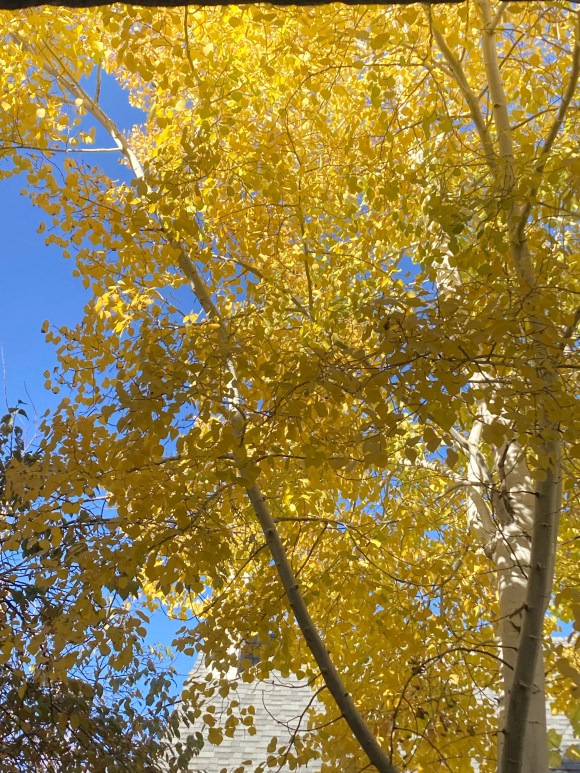
City aspen staying bright after the snow.

Categories
Memoir Writing

Creative Nonfiction: Girl, Alone by Jenny-Lynn Ellis

My mind swirls at the distance I am covering.

Creative Nonfiction: Girl, Alone by Jenny-Lynn Ellis