Categories
Memoir mental health

Summer, 2024

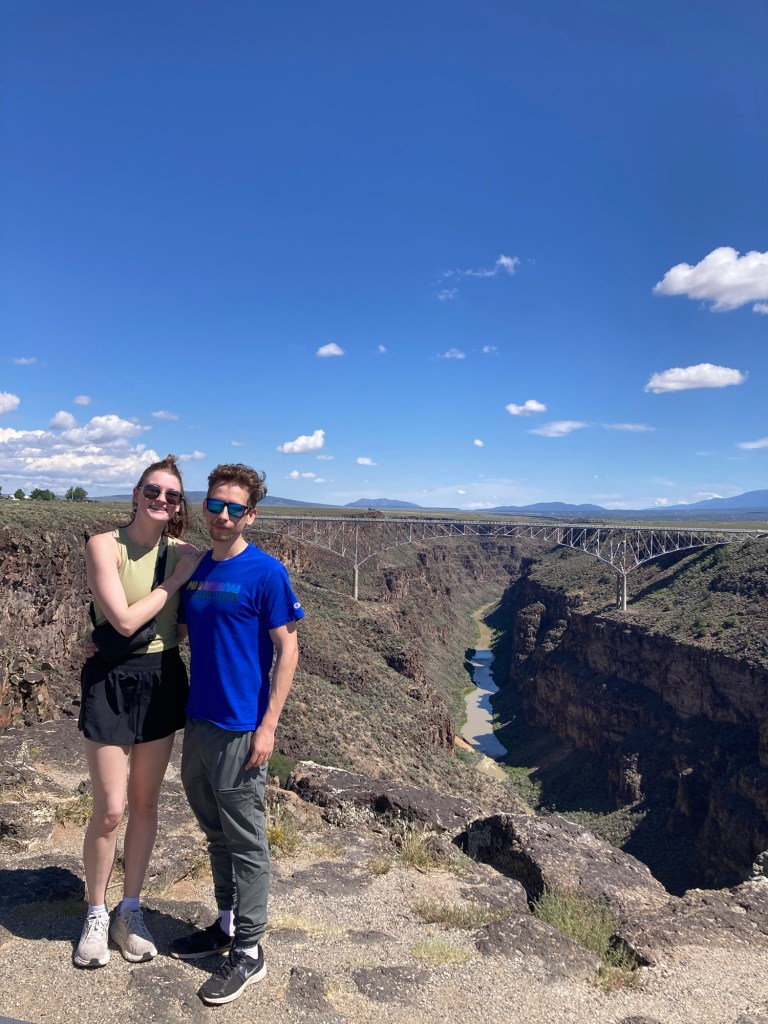
Five of us sit at a round table in a back corner of The Shed, a Santa Fe restaurant with low roof timbers and art on every wall. To my right is my youngest son’s girlfriend, Felicia. Her chin-length brown hair is pulled back in a clip, her long dancer’s legs crossed under the table. Across from her is Weston, my middle son. At thirty, he looks much like his father did when we met, with the same long ponytail and those bright blue eyes. Tom, our youngest and tallest, is often mistaken for Max, who is seven years his senior. They have matching dark eyebrows and smiles that light up a whole room. 

I have started calling this four-day August road trip the “foodcation.”  We have laughed our way through heaping plates of enchiladas smothered in chili sauce and told story after story over chocolate cake and caramel flan.

“Tom,” I say, “Remember when we came here for Thanksgiving, and you couldn’t walk back to the hotel because you were so full?” 

“How could I forget?  You almost killed me making me move around after that buffet!”  We recall the perils faced by youngest brothers who refuse to surrender during eating contests.    

Brad says, “We have some bad memories here, too.”

“Hey,” I respond, “let’s not talk about those sad times.”  Felicia hasn’t heard the Santa Fe chapter of Max’s mental health saga, and part of me is afraid that she will be horrified. Another part of me wants to avoid the belly-clenching fear this story invokes, a fright that has lived inside me like a restless tenant. 

Tom asks, “What happened? I don’t really remember.”  He was only eleven then.  I sigh and look across the room at a landscape painting that conveys the sheltering feel of this high valley surrounded by mountains. Captured in a simple frame are the taupe and green, the unexpected flashes of gold, that animate this part of New Mexico.

“It’s okay,” Brad reassures me and rests his warm hand on my shoulder.  “When Max was eighteen,” he explains, “we dropped him off at college here.”

“It was his dream school,” I add.  “He was so happy when he got accepted. We shielded you from a lot of the details.” I look over at my youngest, who lives half a country away.  “After we dropped Max off, he stayed in his dorm room for two days. Then, when a Resident Assistant checked in with him, he told him that he wasn’t safe. That night, the RA drove north, and we drove south. We met halfway, in the middle of the night, to get him home.”

Weston remarks, “Sounds like a pretty incredible RA.”

“He was.” And I see Max’s pale face as he stepped out of that stranger’s car at a rest stop near Trinidad.  My son’s despairing silence on that three-hour drive lands once again on my chest.  “I don’t know what we were thinking dropping him off at school when he was so depressed.”  A wave of remorse washes over me at the depth of my denial then. I pretended that a little bit of Lithium and a fancy college would make Max well, that his depression would magically give way to the brilliant future we had all expected for him.

I put my dessert spoon down and feel around inside myself for the shame I carried at failing to keep Max safe. My mind holds a clear wish that I had been wiser in those years.  Yet, glancing at the faces of my family, the regret is met by clear, bright gratitude. Max is in Denver today, going to work, building skateboard community, taking care of the dogs.  

Brad has filled in more details of the Santa Fe saga.  “A few weeks after we brought him home, we had to come back and get the rest of his stuff.”   

“Oh, yeah, I forgot that part.”  Our smiles to one another are rueful.

“Tom, remember you were carpooling with Carolyn that fall?  She told me that when she asked you how Max was doing, all you said was that he was really sad.” 

“I don’t remember telling her that, just coming home from school and he was still on that futon couch.”

Weston looks at his baby brother. “Yeah. He was on that couch for a long, long time.”

I nod. “I would go to work and worry about him, but coming home was even harder. I felt like I could help my counseling clients more than I could help my own kid.”  I take a deep breath, switch gears.  “And then he bounced back like a rubber ball, not sleeping, never happier, like his mood grew wings.”

We are all laughing now.

            Dessert plates cleared, we wait for the check. Weston says, “This was cathartic. I’m glad we talked about it.”

            “Me, too,” I respond.  “I guess sometimes the past just gets to be the past.”
Categories
mental health Writing

Flowers of Light

Ten thousand feet on a Friday, and I am happy again. The shadowy November mood flood has finally receded. Along with it, at last, has gone the lingering mistrust of my mind.  

Flowers of light scatter over the snow. Aquamarine and burnt orange glint fire into the winter air.  Weston Pass Road splits this broad field of prism-flowers. My sky-blue skis float over the gathered cold-water specks, cutting paired boat wakes that cast minute waves. In the quiet morning, snow hums a high-pitched “swish.”  My heart drums faster with each push up the hill. Still hesitant to let myself fully reach, to stretch my capacity, I slow a bit and remind myself that undercurrents of grief-fueled sadness won’t take me over today. The season has turned.

I whoosh over last night’s wind-smoothed dusting, then leave the unplowed road to flounder between sets of aspen and over brown tips of sunken grass.  The small slab under me compresses, then sinks with a groan. Are there mice below, whose tunnels have been buried?  Are there fish? 

The more I write, the more grateful I am for the elemental freedom to convey experience, to net up words then plop them down, to embrace imperfection in a moment just like this.

Categories
mental health

Thanksgiving

To not be depressed, again, pretend you are okay. Buy new makeup. Feel the touch of the lovely young woman who steps out from behind the counter and uses a soft brush to smooth foundation over your face. Listen as she tells you with kindness how important it is to blend with care.  After she puts blush on your cheeks, look in the mirror and feel better.  Accept the samples she gives you.  At home, use a cotton ball to remove the layers of pale brown, of cheerful pink, until you look like you did before, just a little less tired.

Avoid going to therapy. Believe you can afford perfume that makes you want to love yourself again, but therapy is too expensive.

Keep exercising, no matter what. You know how to cope. You know you won’t give in. Crave the shelter of your queen size duvet like you once craved summer. Resist the craving. Remind yourself that the living room catches enough November light that even if your eyes are closed, one speck of encroaching darkness might have been frightened off.

When your back starts to hurt, know whose fault it is. Hear the voice blaming you for exercising when you needed rest. Question its logic. The next day, notice that you think you are in pain because you didn’t do enough.  Crawl under the duvet at noon and prop pillows under your knees. Sleep until you feel like getting up. Be cheerful as you eat the dinner your sweet husband made for you. Go to bed early.  Wake up late.

Decide that you can eat all the sugar you want, then do it.  When you wish you could cry, eat ice cream because for a few minutes, you feel like a normal person.

Let your sleep patterns become Fucked Up Beyond All Recognition. Walk around thinking FUBAR, FUBAR. I am FUBAR.

Cancel plans. Stay home. Ignore texts and emails. Anyone who loves you, really loves you, knows that this happens to you sometimes. Wish it weren’t happening as you avoid people who you now think have no reason to love you.

Wake up early today, feeling something. Stand outside shivering under it all as the blue-greens and purples deepen, as they shift to orange and pale pink. Touch your wet face and feel grateful for a kind of letting go. Remember that crying for yourself and all of your invisible losses–that weeping for the world and all the wasted lives—can be a prayer, too, can be, in fact, a form of thanksgiving.

Categories
Memoir mental health

Dunedin Part 3

The Light and The Dark

On the eightieth or ninetieth or hundredth day of my mother’s hospitalization, in the fall of 1980, I sit in the chancel of St Andrew’s Presbyterian Church, wearing a youth choir robe. Palm trees sway outside the sanctuary windows. I feel like a soft-limbed robot, and whatever I sing with the other altos, I sing with fear in my throat. I don’t know the word “sepsis” or that my father and oldest sister in Washington have been told to prepare themselves for Mamma’s death. I do know about fear. I know about having been bad, and about wanting another chance to be good.

On that morning, as I try to pray, my thoughts are shards of porcelain, sharp behind my eyes. Then, all at once, a bright warm light comes into my mind and lifts me out of broken thoughts. The light surrounds me, telling me without words that I will be all right, that I don’t have to be afraid. Warmth moves from the top of my head to the tips of my toes. This lifting up and calming down happens in an instant.

It could be that this exact light extends from my mind and heart and body to the mind and heart and body of my mother. Maybe you believe in something like this light, or in coincidence, or in a traumatized girl having a delusion. At different times in my life, I consider all of these. What matters is this: on that Sunday morning, my mother wakes up asking for food, for someone to please wash her hair. Instead of dying that day, she begins her recovery. And as soon as she is strong enough, my father brings her home to us in Dunedin.

Maybe because she is so skinny and pale, her eye sockets huge, that my mother seems to glow with life, to look at Florida and each of us with wonder. A snapshot of her in a wicker chair on my Aunt Barbara’s porch shows her with bony arms akimbo and legs crossed under a draping skirt. Her face is turned sideways, her cheekbones shadowed.

As her step steadies and her eyes soften, the mechanical in me recedes. I settle into her presence and into her touch. She smooths the hair from my face when I worry at night. I feel her hand and I feel her warm arm like a shawl around my shoulders.

One night, in the moist air of early winter, my parents dress for a party, he in a white shirt and dinner jacket, she in a rayon dress and low-heeled sandals. As they get into the car, my father hands my mother a cocktail. She looks down into the plastic cup filled with vodka and 7up and raises it—unsmiling–to her lips.

Panic lifts me from wherever I am standing to a view of the drink from just outside and above the car. What must that moment have been for my mother?  I imagine her having held those months of sobriety like an anchor rope growing heavier every day, until she had no choice but to let it go. 

Once again, she sits alone in front of the television for hour after hour. And once again, I start sitting with her, determined to help. On random nights, she drink-talks to me about her father not letting her go to college, because education is wasted on girls. Her voice slurs telling me how terrible it is to depend on a man: Never be stuck like I am! And tears streak her mascara into half-circles under her eyes.

Trying to save her from the shadows becomes my own night-time compulsion. I listen to her, and I shush her. I help her to bed and pull a sheet up to her chin as she tells me how sweet I am, how much she loves me. Rescuing her is my penitent duty, a chance to make up for every cigarette I ever stole from her, every lie I ever told, and every time I hated her. Like the hangovers and blackouts she must have suffered, I feel the after-effects of self-martyrdom like a slow, blistering burn. I am exhausted and increasingly confused. How, when she gets up the next day, can she not thank me for taking care of her?  I redouble my efforts to help and be good, to distract myself from the accumulating darkness of my resentment.

Categories
Memoir mental health

Son, to Part Shade

Where bold sun once beat down on hard dirt and where fresh lavender stalks pushed purple blooms toward our bright star, here we planted a tree in honor of his birth. I kneel in its dappled shade, hands coated in black soil. The sheltering arms of his skyline honey locust touch our high roofline now. Its long, brown seed pods litter the ground every summer. In the dappled shade of its yellow leaves, I seek patches of sunlit ground for pollinator plants.

This flower bed is supported by a rough line of heavy mountain stones, white and gray-veined chunks with sharp, angled corners. From the crook of one stone’s elbow, I lift a small gray rock and rest it smooth and flat against the palm of my hand. Too small to hold back dirt, too warm and smooth to throw away.

How is any rock much different from the smaller specks that clump together to make dirt? How different from molecules of air, for that matter? We move through gas particles. We inhale and exhale every day.

I need this garden like air. Its beds surround the place where I planted my adulthood, where I pulled toddlers’ jackets tight against the wind. In this yard, we turned rocks upside down to see rollie-poly bugs, to marvel at worms and centipedes. We strolled the block to gather red maple and oak leaves, then we ironed them between sheets of wax paper. Day after bright, shining day.

My hands, so much like my mother’s now, have lifted and turned this soil for thirty-three years. These palms once cradled three infants in turn, held close the start of three lifetimes. One life nearly cut short by despair and a handful of pills.

Still breathing. Still breathing. Still here. Bee balm. Astagache. Butterfly bush. All compete with weed after weed after weed. I will work this flower bed, mixing compost into clay, planting everything bright thing I can. Until the snow flies, until bitter cold casts mist from my mouth, then, when spring lures colors from these tender plants, I will kneel down once more.

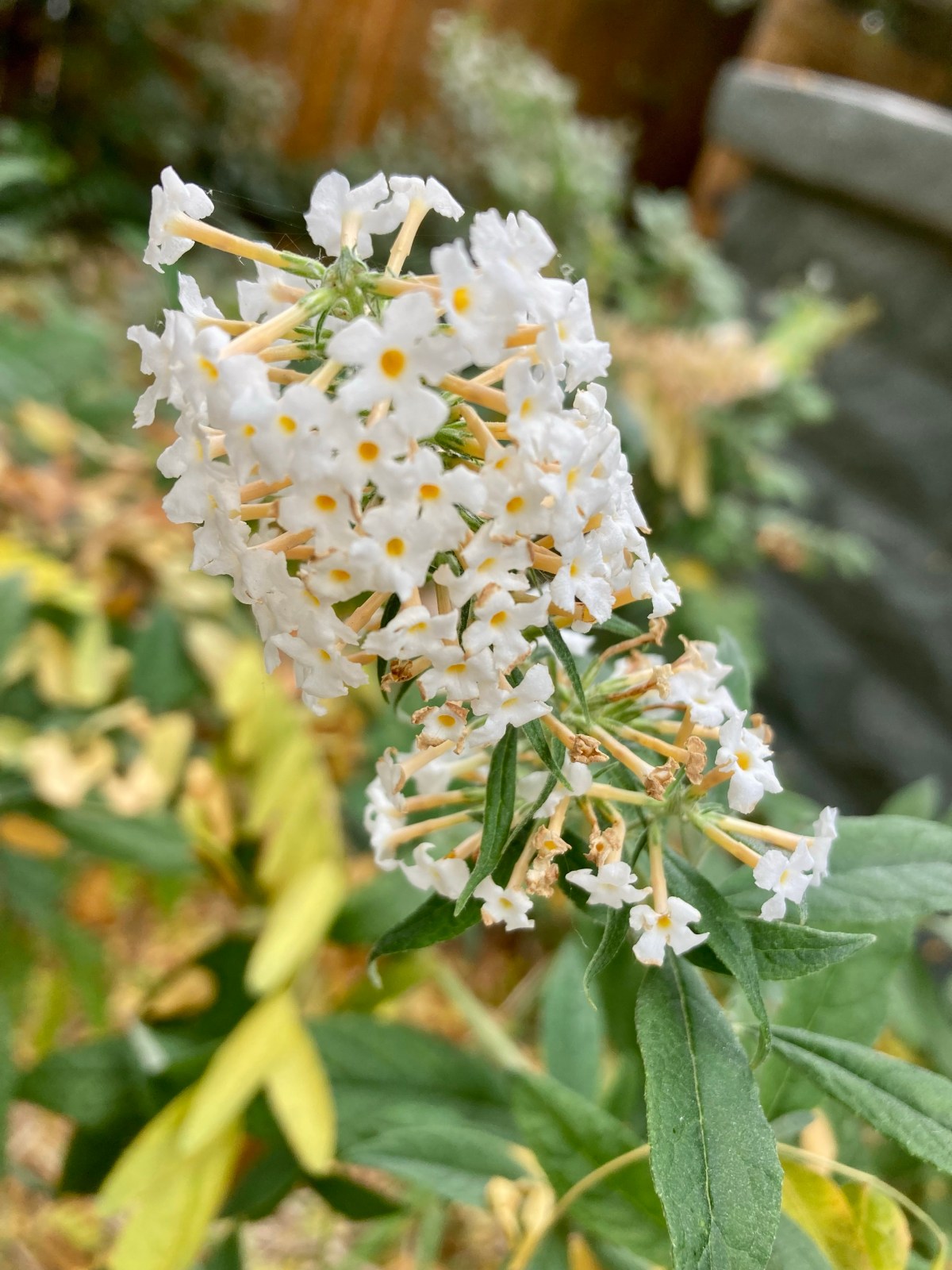
Back yard astagache bush, also known as hummingbird mint.
Categories
humor mental health

Crankxiety

Dry means dry, I think to myself, as I watch a big metal cylinder flip my clothes around and around. I’m frowning, arms crossed, in a July-hot laundromat in Chesterton, Indiana. The husband thinks that dry means done, which means he takes clothes out of the dryer when he’s tired of waiting for them, even if the necks of my t-shirts and the toes of my socks are still damp. How wrong he is to not understand that dry means dry! How frustrating when he does things wrong! I watch myself agitate, feel my shoulders and jaw turn to gravel. At that moment, dear reader, the husband is six hundred miles away. His laundry misdemeanor occurred a week earlier.

Cranxiety: the crunchy combination of grumpiness and worry.

Everywhere I go, cranky mixes with anxious into a new kind of miserable. On a hushed mountain morning, the husband walks by as I write, on his way to the kitchen for a cup of tea. His footsteps and the kettle’s hissing jolt me into worry that I can’t write, not now, probably not ever again. Why can’t he just be in the other room until I’m done? And why must I be so ill-tempered?

Crankxiety is what happens in my head when the wifi goes out. Where does the wifi go when it goes out? When will it come back? I ruminate on how wrong I am wrong to focus on what is wrong. I am supposed to be sweet, happy, and productive. I am not supposed to flip out when the husband makes tea or the wifi goes for a walk.

Cranxiety is part of what led me to re-start therapy last spring. A few weeks in, I got into an argument with my therapist. Jenny-Lynn, he said to me, so kindly that you would have thought he was a nice person. Hot tears were streaming down my face. Damp tissues were wadded in my left hand. Jenny-Lynn, he said, it is all right to feel. My objection was immediate and visceral—opposition from my toe joints all the way to the hardest part of my skull. I only wanted know why I was crying so I could stop. But I didn’t know why, and I couldn’t stop, and for some reason, I hated that he told me it was okay.

For me, anxiety is a despairing and physical need for everything to be different, inside and outside myself. It is a belly churning worry over the past and the future, including how much worse the anxiety might get, and how much crankier it might make me.

A few days after my laundromat diatribe, I tell my doctor, Crankxiety is a new circle of hell. She nods sympathetically as she fills my first-ever prescription for an anti-depressant. I’m not depressed, I report, I am just miserably irritable. Eight weeks after starting a low dose anti-depressant, crankxiety still rears its ugly head, but its talons don’t grip my belly for hours or days at a time. I can shrug and go on with my next, more helpful thought. I don’t have to be different, and neither does anyone else. These days, I say to myself, Jenny-Lynn, it’s all right to feel sad. It’s all right to feel anxious. More than anything, I feel more like myself, complaining and sweet in turn, and just exactly good enough.

Categories
mental health

Yeerk Pool

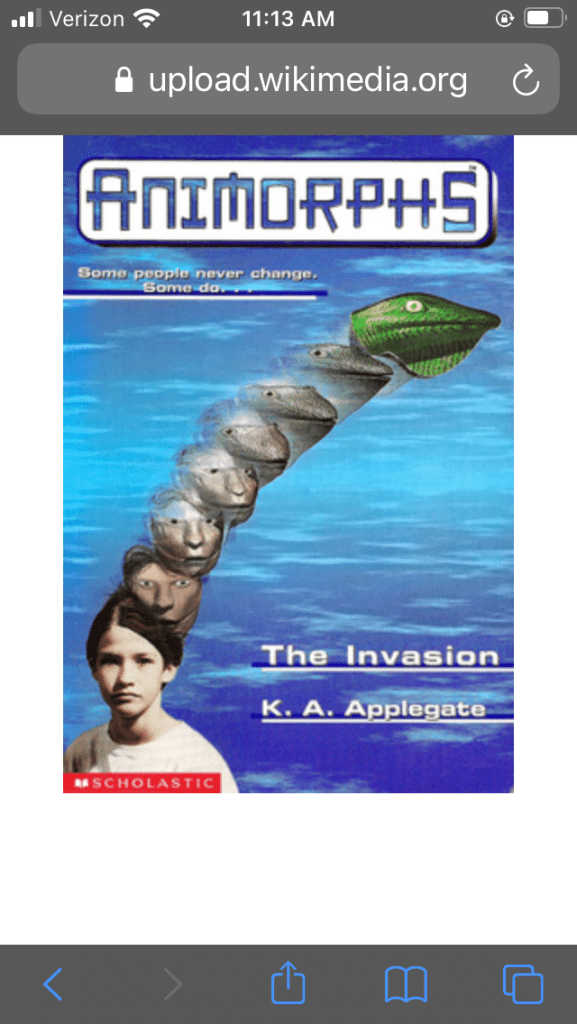
When my boys were young, we read K.A. Applegate’s Animorphs series, about alien worms who crawled into people’s ears in order to take over their brains. These interstellar slugs were slowly conquering the world. At regular intervals, the alien worms, called yeerks, returned to their collective pool to regenerate. Human hosts, controlled by the aliens, would lean down at the edge of the goopy water as the slugs oozed out to do their yeerk thing and strategize about how best to control the universe, one slugged brain slug at a time. Luckily, a group of intrepid young humans had gained the ability (from good aliens, of course) to morph into animals. So, as soaring hawks or hive-brained ants, they waged covert battle with the yeerks.

When my son, now thirty, has bipolar depression, as he does today–immobilized by invisible neurostorms–I think of the Animorphs shouting to each other, as they prepare for yet another impossible mission, Time to kick yeerk butt! And off they go to save the world.

Screen shot of one of the first Animorphs book covers. “Some people never change. Some do.”

When I meet someone who might become a friend, I often take the risk of disclosing that my son carries a bipolar diagnosis. Then I brace myself for the harshness of the typical first question:  Is he taking meds? Or recently:  Is he taking drugs? “Drugs?”–that one stumped me. Were they asking if he also has addiction, as so many folks with bipolar do, or were they blending the term for prescribed medications and street drugs? In these conversations, I often hear about someone’s sibling, ex-partner, or parent who struggled with mental illness. But the medication question almost always comes first. As if medications are a fix, as if surrendering the brain to psychiatry makes bipolarity disappear.

The “take medication, be fixed” way of thinking is familiar. I thought that way myself a dozen years ago, when my son was an intellectually gifted teen with a rebellious streak. Before his first real manic episode bloomed like toxic algae, before our family’s genetic pattern was revealed. Before I visited my elderly mother in the psychiatric ward, and before two of her other grandchildren were also diagnosed. For so long, I didn’t know I was thinking, why don’t people just take their medications? But I was.

Every year that goes by, I am more and more grateful for the miracle of modern psychiatric medications, for the lives they improve and the lives they save. And still, more than once, more than twice, my son has been following every recommendation of a complex treatment plan—medication combinations, support groups, highly skilled on-going psychotherapy—and boom, he is hit, as if by a stray bullet. Up he goes like a shining, untethered balloon. Or down he goes into the dark pit of depression. These cycles leave him facing yet more lost opportunities, yet more go-rounds of self-blame. The yeerks are at it again.

How to be a mother on days like this? I want to morph into a bull elephant and drain the pond where the alien yeerks strengthen, where they strategize ways to rob humans of their freedom and self-command. I try instead to stick to my known super-powers, encouragement and food. Every day, I tell him I love him and ask if he’s eaten his vegetables. I text him funny memes, even when I know his phone is off. I buy organic spinach and kale, heaping it onto his plate at every opportunity. Of course, no amount of mother love can banish symptoms. I beat back my grief and helplessness. I battle my destructive impulse to make everything right by sheer force of will. Then, slowly sink into the hard-won understanding about my mother, my son, myself: all of us, always, are doing our best. Yes, it helps to take medication, and no, even the bravest heroes are not always cured. But on they go, day by day, season by season, kicking yeerk butt.

Categories
biking Memoir Writing

Beetle Murder & Bipolar Disorder

Japanese beetles are iridescent green, shiny–and beautiful. I admire the engineering genius in the strong grip of their tiny claws and the protective shell of their winged backs. I murder them because they feast on all my favorite garden plants: Virginia Creeper vines become laced skeletons; rose and hibiscus blooms are hollowed out before they can unfurl. Day after day for three summers running, I killed the destructive fliers by the hundreds–shaking them into drowning bowls of soapy water.

This summer was bountiful, disorienting, and full of noxious invaders. Covid 19 seemed to be exiting stage left while we adjusted to socializing and the smiles of strangers, then—well, you know that story. Between visits from long-missed friends and during breaks from clouds of wildfire smoke, I was on the couch or on a bicycle. My write-ride-repeat summer plan quickly became a ride, read-a-little, ride-some-more reality. Then all of a sudden, there was snow on the deck, and I hadn’t written in what seemed like forever.

I had fought a losing battle with hungry beetles in the city, and with noxious knapweed in Fairplay.  Knapweed is a thistle that sprouts in soft green tufts in the spring only to morph into two-foot high shrubs holding hundreds of needle-sharp seed heads. It has been my enemy roughly since the time that my son was diagnosed with bipolar disorder, which was around the same time that my mother was dying. My therapist then heard a lot about knapweed. And she once asked me to say out loud the names of each person I loved who had died over the previous eighteen months. I only made it to four, about half way, before losing track and crying. But I pulled a lot of knapweed that year, grateful for one thing that I could destroy back.

This August, while I was obsessing about beetles and knapweed instead of writing, Sunlight Press published an essay of mine that included more about bipolar disorder in our family than I’d written before. Encouraged by the journal’s editor, and with the full blessing of my son, I connected the dots between my mother’s illnesses, my own first major depression, and my son’s bipolar diagnosis. (Have a look if you missed my post about it on Facebook: https://www.thesunlightpress.com/2021/08/22/colfax-and-monroe/).

The more I write, the more I learn to write about (if not publish about) the hardest things. I step into those memories and experiences not out of self-pity, but because they are the truest stories I have. They help anchor me to my current happiness, providing contrast, expanding my gratitude. Maybe those stories also have the most potential to help others.

I chose to become a therapist many years ago because I wanted to be part of transformational conversations, and to be genuinely helpful. Maybe I was most helpful on days that I felt like a failure in my own life, when I was blind to the generational patterns that look so obvious in retrospect. Maybe the counseling I offered on days when I showed up to work confident and energized were my least helpful days in the profession. Possibly, the days I needed to cry in the parking lot for an hour before I could walk into my office were my days of most lasting service to clients.

No shining cosmic memo will tell me that something I did as a therapist or wrote since that time made a real difference to another person. But, like the genuine practice of psychotherapy, a genuine writing practice shifts me away from my petty, narcissistic side and toward a vision of a better world. Beetles and knapweed and bipolar and all. Looking deeply inside ourselves and telling the truth about what we find there, is, I believe, inherently healing. And the more I write, the more of that I want.

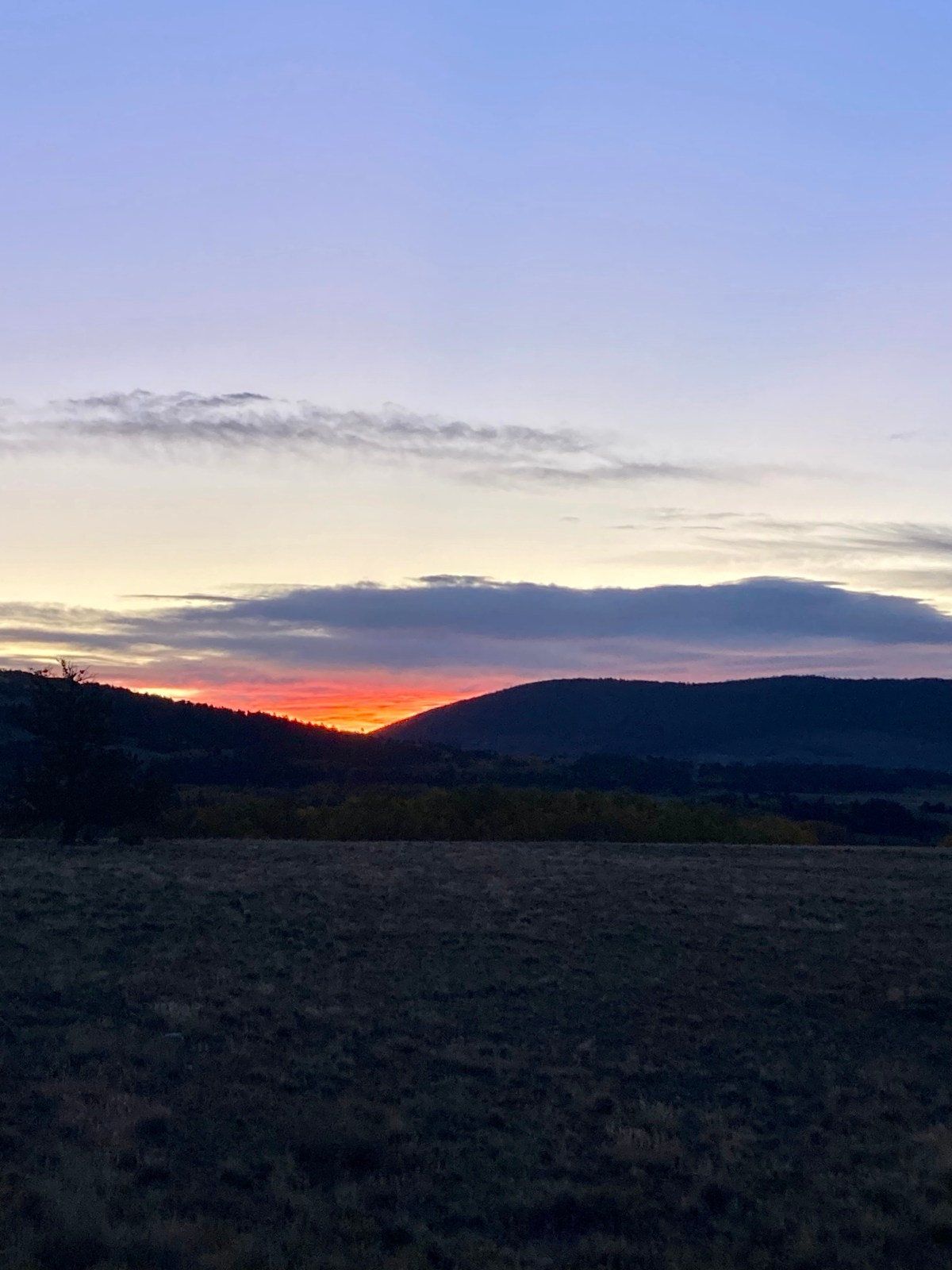
View from an evening ride.
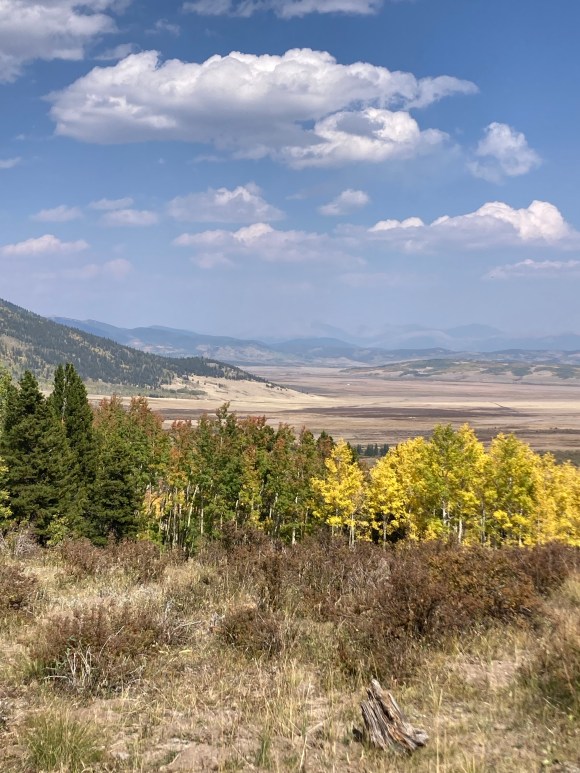
Looking toward Kenosha Pass
Late summer sparkle.

Categories
Memoir

Colfax and Monroe

In 1985, almost twenty and on my own in Denver, I worked as a hostess at a restaurant on the fringe of downtown. Legend had it that the building–three narrow floors encased by roughhewn brick–had once housed a brothel. My manager called me the “door whore” and made sport of sidling up to me to brush his hand against my behind.

The gleaming wives and glittering girlfriends of Denver’s powerful men would sashay through the large glass doors with a gust of winter wind. Standing next to my podium, they shrugged off their fur coats for me to catch mid-air. I hung those expensive wraps in a long, oak-paneled room that soon filled with the smell of designer perfume—Cline’s Obsession, Dior’s Poison. During lulls on busy Saturday nights, my fingers brushed along the comforting softness of mink, raccoon, and fox. At the end of the night, rich men veiled in cigar smoke filled my tip jar with five-dollar bills.  Their cash paid for white Russians at the corner bar, or– sometimes—for lines of cocaine at all-night parties.

Finally away from the small flat house in Florida where my mother drank and raged, the sane and stable independence I’d envisioned eluded me. Instead, a gnawing loneliness festered under my rib cage, growing sharp and dangerous edges.  I shared an apartment off the corner of Colfax and Monroe–a block from the number fifteen bus downtown–with a roommate I once hoped to befriend but now avoided. A few nights a week were spent with my boyfriend, who liked to “wake and bake” on his days off, pressing his mouth to a bong as he sat up in bed, then raising his glazed eyes to the late morning.  Sometimes, he and I would walk from his place near Cheeseman Park to a small grocery and buy Soft Batch cookies to binge on together. The chemical sweetness of those cookies was choking, but like so many things then, I thought I could take it, that I should be able to withstand any discomfort, no matter how tainted.

That second winter away from home, a long coke high morphed into depression and thoughts of suicide. I sat in the back of a cab one night after work, under the midnight streetlamps, and watched the reflections of tidy brick bungalows flick past the window.  Families lived there who were safe and normal, people who knew how to be good, to be happy. As the cab pulled over on Monroe Street, I quietly handed the driver a small wad of one-dollar bills.

As I entered the dark vestibule and trudged up the grimy flight of stairs to my apartment door, my tabby cat meowed her insistent welcome. In the bathroom, she waited for me to pull dental floss along the cracked linoleum, then pounced on the white thread in mock ferocity. She turned on her back, and I knelt to play my fingers over the warmth of her belly. Batting at my hand, claws retracted, she purred. When we went to bed, she curled into the bend of my knees while I cried in the dark. I could never abandon her.

On the back page of Westword magazine, near the personal ads and photos of escorts for hire, I found a therapist with a sliding scale fee. Esther was tall and beak-nosed, her dark hair faintly shot through with gray, and her gaze both alert and tender. Session after session, she listened to my stories, then offered a brief hug as we said goodbye. When Esther told me You’re a very strong person, I believed her. Before long, I registered for classes at the Denver campus of CU, toting shiny pumps that I’d slide on after class to hostess the dinner shift.

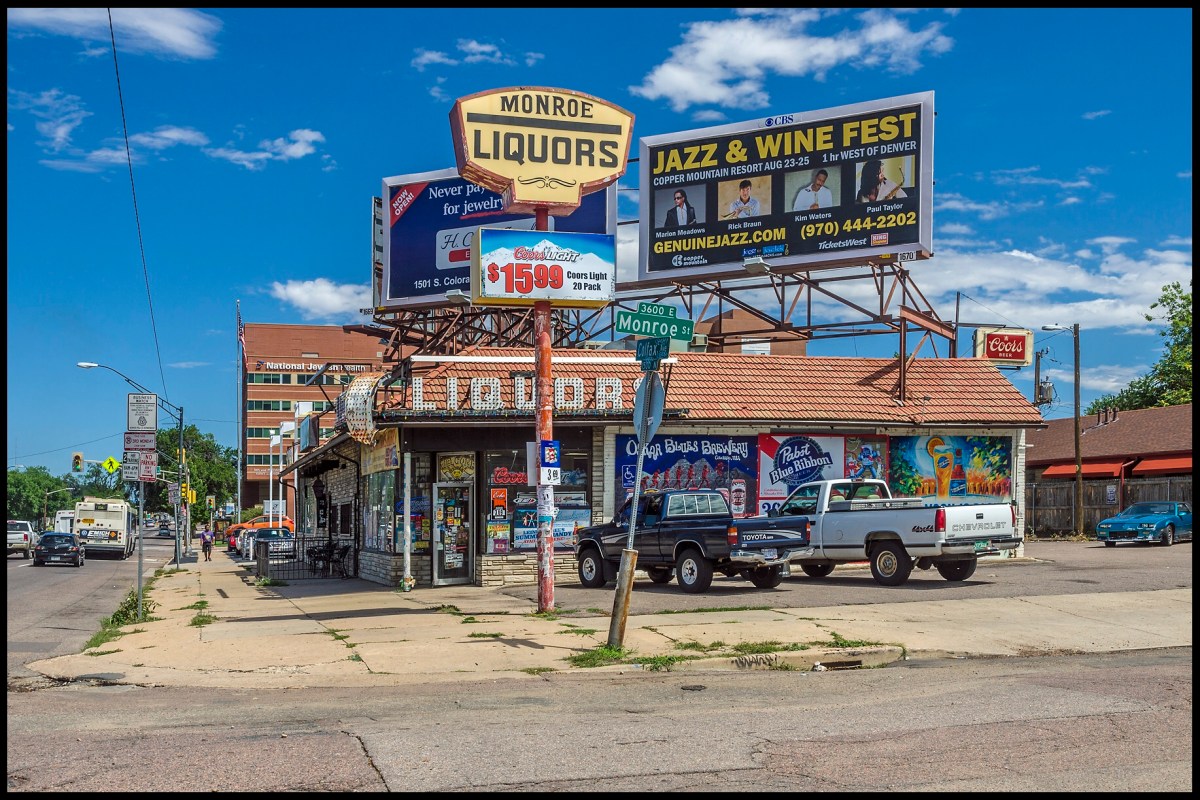
I didn’t understand–as I started my adult life that year–how my moods would continue to cycle. The tentacles of sadness that wound around my chest in November would sometimes swing upward in spring until I was filled with more energy than my body seemed able to handle. Much later, my mother’s family tree was lit up like a hazard sign with bipolar symptoms and diagnoses of her siblings and grandchildren. While my mood problems never crossed the threshold to that diagnosis, my patterns of withdrawal and impulsivity were much like my mother’s and—like hers–driven more by heredity than lack of effort or love. Now and then, with my grown sons, I will drive past the gentle slope of porch roof where my old cat would lounge on sunny days. Inside the upstairs bedroom that was mine are freshly painted white walls and a whirring ceiling fan. The neon light of Monroe Liquors still glows on the corner, but across from its parking lot are an upscale restaurant and a pie shop. Like a tour guide, I have pointed out to my family the landmarks of my lost days. My boys know well the vulnerabilities they’ve inherited, the tender traps they must navigate as they map their own adult lives.

Categories
Memoir

Porch Light

In 1982, Aunt Mardi and Uncle George lived about a mile away from us in the small town of Dunedin, Florida. At Sunday pool parties, my mother would step away from the barbecue to watch Mardi and George pose on the diving board. Mardi was tall and curvy, her hair a frizzy halo over her oval face. George was round in the middle, his hair as straight as his stick legs. He gazed at his wife with exaggerated rapture while sunlight glinted off the still water. They clasped each other as if to waltz, looked up at the sky, then tilted head-first into the deep end. We all cheered. They called this splash-up “the lovers leap,” and they surfaced laughing, dark hair dripping into their eyes.

Aunt Mardi smoked Virginia Slims, holding the long cigarette between her fingers while telling me she really should quit. She drank wine or Manhattans with compulsion-free pleasure, and she was on everyone’s side, somehow, never arguing with my parents, never making anyone wrong. In those years of Mom’s relapses and undiagnosed manic-depression, I soaked up her generous mother-love. At fifteen, I began to unravel like a ball of yarn rolling downhill, but Aunt Mardi’s kindness and sanity buffered my fragile psyche.  Her help was practical and steady, a simple hand on my shoulder, a warm and encouraging smile.

For a few weeks of my sophomore year, I hardly slept at all. A panic attack slid me to the floor in math class.  Images of death overwhelmed me if I tried to rest. One night, I used an alligator magnet to post a drawing of a coffin on our beige refrigerator.  My alarmed parents called my Aunt Maralyn, a doctor, who sat on my unmade bed with me, her voice low and soothing. She told me, I work with a young woman I think you would like. She’s a psychiatrist, a doctor who helps people with their feelings, too.

Like a counselor? I asked.

Yes, like a counselor, but also a doctor, like me. I think it might help you to talk to her.

Aunt Mardi drove me to one of my first appointments. She waited for me while I sat on a leather therapy chair and revealed carefully chosen bits of myself to a competent stranger. It was Aunt Mardi who confirmed to the psychiatrist that, yes, my parents sometimes drank too much, that the stories I told about them were probably true. After a few sessions, I was prescribed little pink sleeping pills, each tucked into a clear bubble of plastic. For a little while, my parents gave me one at bedtime, but kept them hidden from me during the day. I soon finished with therapy, but soaked up sanity at Ala-Teen meetings. I learned to meditate. I got a job and counted down the months to high school graduation and freedom.

Meanwhile, Aunt Mardi and Uncle George left a key hidden on the metal shelf above the porch light of their little house on Douglas Avenue. If my mother was having an especially bad night, I got dressed and walked out into the humid Florida night. I turned right onto St. Anne Drive and walked past the rectory, a low, flat building set back from the street. I pulled the night air into my lungs and stomped outrage into the asphalt of the huge church parking lot. How dare she?

On the shortcut past the elementary school, the darkness was near-total. I felt small under the looming branches of live oak. I slowed my pace until I saw the tall palm that marked my turn onto San Mateo Drive. The songs of tree frogs and the pungent scent of swamp water drifted to me from nearby Hammock Park. By the time I turned left onto Douglas Avenue, my anger was spent. Aunt Mardi’s porch light glowed softly above her front door. As I reached up and felt the grooves of the house key under my fingertips, I was steadied. Secured. I set the key on the wooden table inside the door and felt the hush of the house gather around me. I tiptoed through the kitchen into the guest room, then pulled out the sofa bed. Drifting to sleep, I knew that the next sound I heard would be my aunt and uncle sharing quiet coffee talk while the sun warmed their back yard.