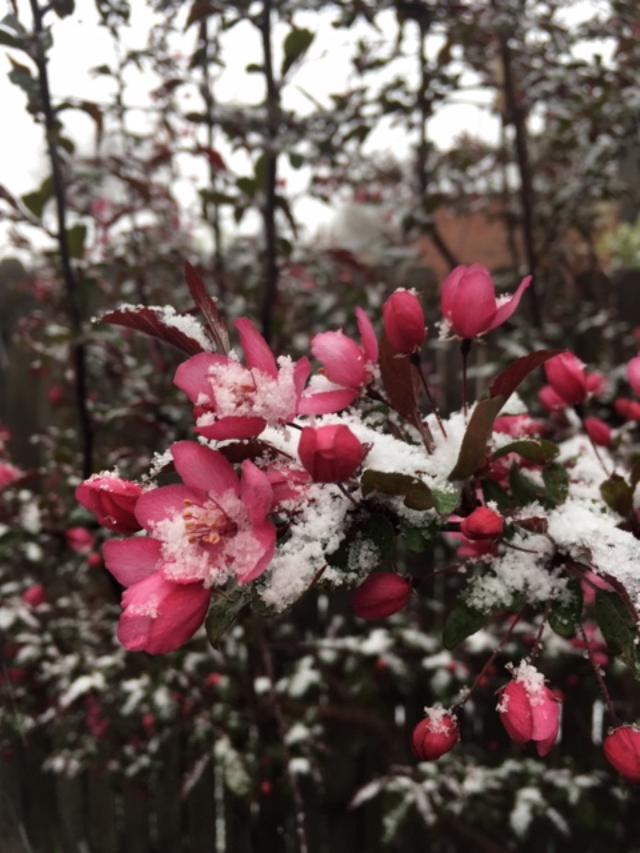
It’s a three-season week in Denver—technically spring but with a recent day close to 80 degrees and snow in the forecast for tomorrow. Above my back-yard fence, recently unfurled aspen leaves touch each other in surprise, too soft to make a sound as the breeze floats their fresh green in slow cirlces. The fountain tinkles water into the bird bath, and a bee buzzes past—a cliché of this season I can’t resist. The goddess Nyx, regal in her shimmering black coat, steps dainty paws onto the mulch behind the blooming crab-apple. She eats a blade of grass then retreats to the shade of the house.
The sun over my left shoulder tosses shadows from my damp curls onto my notebook paper. If I look inside the dark loops scattered across the page, rather than at them, I see moon shapes and slices of pie. I tilt my head, and bright oblong footballs give way to a constellation of marbles, light circles planets plopped onto a newly discovered cosmos. Half a block away, a chainsaw jets raw noise into the stillness, and suddenly the magical universe of miniature shapes becomes just shadows on paper.
Dogs bark next door. My hand moves over the page, determined to find dreamy stillness again.

The hundred-year-old maple across 24th Avenue has only the faintest green on its twig tips. With age comes caution. The mass of its old trunk holds as much wood as five of these quaking aspens, with their heart shaped leaves. The sun heats my arms into beaches and sandbars. On goes the chainsaw, then off again. Vroom. Quiet. VRROOM. Into one lull drops the click of a fence latch as another neighbor steps into her yard. A mourning dove coos, supplicant and charming.
The more I write, the more I appreciate the variety of stillness and interruption in all of my favorite places. Peaceful mountain meadows erupt into thunder claps, or into the rattle of disturbed grasshoppers. The loud stare of a moose stops quiet thought faster than any city siren. She might as well be yelling as your eyes meet on the muddy road: I will bash you. Just give me an excuse.
City quiet, though, is especially rare, an almost inner hush as traffic sounds and background rumbles miraculously cease. The multitude of neighborhood children all sigh into contemplation at once, daydreaming in unison. An hour west, the mobbed spring ski hill also silences unexpectedly. As the crowd swishes down a popular run and the chairlift creaks overhead, I take one short turn toward that pair of pines, and a celestial mute button silences everything but pure light, inside and out. In high volume motion closer to home, as I cycle next to a tumbling creek, perfect silence descends, startling as the cry of a blue jay in this sunny back yard.
A squirrel clacks and squawks at me from the top of the magnolia. Its tail twitching over its head, it spends its outrage then offers a friendlier noise from low in its rodent throat, its contrite little heart telling a story all its own. The chatter of the world meets my determination to making something in stillness–despite or in harmony with this creative symphony of interruption.
Will I learn to listen to the noise and the quiet? I crave motion and distraction as much quiet contemplation. I fall in love with the messy world all over again in the spring, my attention leap-frogging to the next season. It’s easy to be infatuated with summer when it’s not here yet, roasting both city and forest. It’s easy to be happy now, as a white butterfly slips through the holly-spikes of the mahonia bush laden with blooms. I marvel at the tender clematis vine threading itself into the air above the fecund earth. Yesterday’s heat has singed the late tulip petals and sent the hyacinth into retreat, but I’m in love, falling into spring with all of the irrational anti-gravity of romantic bliss.
A baby cries across the fence, his first warm season begun. In my house, the husband clatters a baking sheet into a drawer, jarring yet more sound to me through the open window. Voices take up conversation in the front yard. I crank open the green umbrella for shade, but keep the right half of my body in the white-hot light.
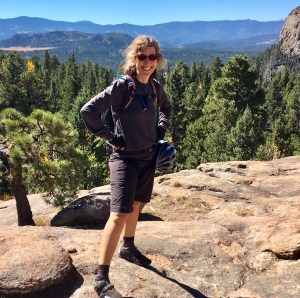 orning, I stood in the Buff Creek parking lot with a group of very fit mountain bikers–mostly women and mostly racers. My friend Mary—gregarious, blonde, and seriously strong–made introductions. This is Jenny-Lynn. She is an amazing writer, she said. Even when spoken clearly, rider and writer sound almost identical, so I quickly clarified that my kind friend was talking about writing, and that, as a rider, I would do my best to not slow down the group. Seriously, don’t wait for me, I said. I’ll be fine.
 This continent that birthed the human race so long ago is now home to my niece, Rachel, who works as a researcher for one of the many non-governmental organizations in Lilongwe, Malawi. When she arrived to pick me up at the airport, I greeted her in Chichewa: Moni. Muli Bwanji? I have practiced the simple Hello, how are you? many times on the plane, but these short phrases don’t stay in my travel-soaked brain for long.
 closely related Nyanja dialect. My polyglot niece doesn’t get to practice her French, Spanish, or Russian very often while living and working in Africa. I, however, thanked a Zambian immigration officer by saying Gracias, and I greeted Rachel in the morning as I do my sons at home, in my mother’s Icelandic: Godan daginn allan daginn. It means “good morning, all day,” but Rachel gave me a quizzical look in response.
 quick breath to peek at the world and then swim-doze the day away. Mesmerized by the adorable ear-flapping, I can’t look away. My laptop goes into sleep mode. At this point in the trip, I am the dependent one, following my niece around like a baby duck to mooch off of her WiFi hot spot and translation skills. Rachel makes me coffee and cooks me oatmeal before she opens her computer and starts running data sets for her project–actually working–as I gaze at the fast-flowing river.
 flags, first the mother, then the imitating baby waving their ears in synchronized tempo before ambling away to snack a different set of shrubs. I surprise myself by wanting to cry. The elephants are so wild and intelligent, so distinctly and fiercely familial.

 Last fall, I started making the short trek three days a week for a “Getting it Done” pomodoro class in the Lighthouse attic. Pomodoro is Italian for tomato, and the moniker for a time management system originally developed on a tomato-shaped timer. Twenty-five-minute work segments alternate with short breaks and add up to four hours of productivity–it’s harder to distract oneself with nonsense in a room full of (seemingly) focused people. I committed to twelve hours per week of butt-in-chair writing time, and sure enough, things got done. At first, in the former ballroom turned writer’s aerie, I quailed with insecurity sharing space with “real” writers—cracker-jack memoirists, a superstar humor writer, and a sci-fi smarty-pants.
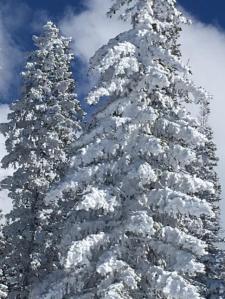 tumbling into my boots. Two bundled men chatted as they shoveled their next-door walkways. One leaned his forearm on his shovel and looked up into the swirling white. What a beautiful snow! he said.
 counts out M&M’s for me and my sister. We get fifteen each, in small metal cups meant to hold soft boiled eggs. I have polished Daddy’s black shoes until they shine. They sit on a section of newspaper by the kitchen door, waiting. Save your M&M’s, Mamma says, before our parents drive off into the evening. Make them last a long time!
 After the local news, Rod Sterling’s voice describes the time I dread: The Twilight Zone. I am sleepy, but I won’t go into our room alone, so I put a pillow over my head and drift off. I don’t wake up when my father carries me to my bed.