When she was a lanky teen, miles taller than I was, my sister Kristin once let our mother pluck her eyebrows. Her blond head on Mamma’s lap, face contorted into a grimace, she allowed our mother to tweeze the rectangles above her eyes into surprised arches. Then Kristin stood in front of the hall mirror, fuming, as tiny red welts appeared where errant hairs had been removed. In the weeks that followed, brown spikes grew back into their natural place above Kristin’s eyes. They were not plucked again.
My mind’s eye sees clear memories like this one only after a year of struggling to write anything worth keeping about Kristin. I stopped every single time I re-read this odd statement of mine: “Over the years, Kristin and I had managed a polite but respectful distance from one another.” It didn’t strike me as a lie so much as just a weak sentence. But those easy words lifted me into a comforting cloud of dishonesty, far away from what I really felt about my adored and feared big sister.
The truth about my relationship with Kristin–and about her life–is complicated and painful. She was adopted by my father and his first wife, making Mamma her third mother. She had unpredictable bursts of violence when I was little, leaving me watchful and wary. And when Kristin died unexpectedly, six years ago, she was only fifty-four. Honest and graceful words elude me. Kristin was a nurse and a daughter, a sister and a rebel. What I called “polite but respectful distance” in our relationship was simple fear. I was slow to open my heart to Kristin, almost to the end.
A few weeks ago, I received a personal and encouraging rejection email from a journal editor who asked for a revision of an essay I had submitted, an essay about my mother and her Icelandic homeland. The rejection note included the words “very well-written” and “interested and invested in this essay”. I was—and am—thrilled. The editor suggested that I expand and clarify the relationship dynamics between me, Kristin, and my mother. I had included Kristin in my story, but only as a ghost, not as the girl who had hit, or the high school graduate who had left for Iceland, then come back, before leaving again, for nursing school in Chicago. In that essay about my mother, I had blindly left Kristin’s story out.
So, day after day, I re-write, giving Kristin real space on the page. I try and I try not to lie. I describe her awkward place in the middle of our big family, where she stormed in justifiable outrage. I see her body, recovered from anorexia and from alcoholism, but never fully healthy. I write about Kristin’s decision not to see any of us for a long time, and about the grace in her decision to come back to us while our parents were still alive. As I write, the tears flow and the words float like icebergs freed from a glacier shelf. I sit at my keyboard, tapping with one hand and wiping tears with the other.
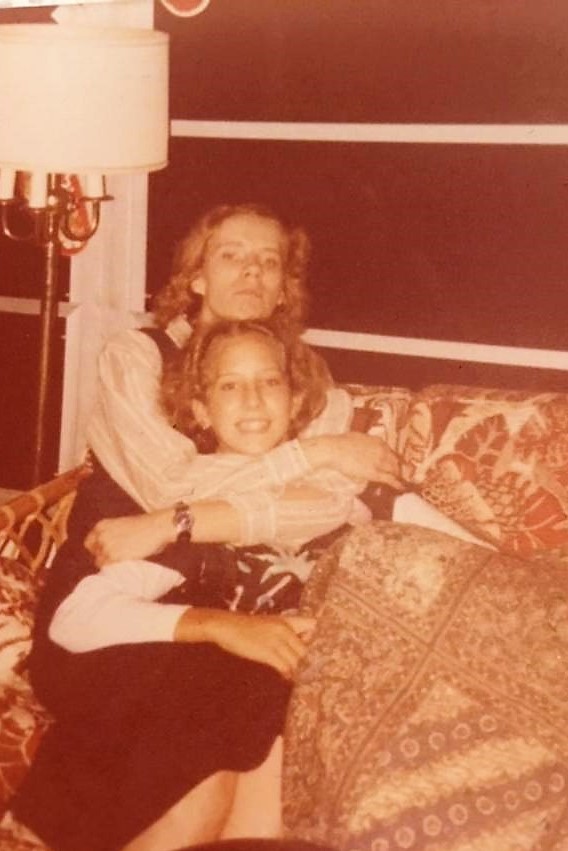
The more I write, it seems, the more I get to trust the process, including my blind spots. And today I am so happy to see the Kristin who looks out of this photo, holding and shielding me. I have missed you, big sister.
 Stand near a sunny window and look at the succulent jade. Think of your mother, and try shopping. See her lines on your face. Love them into deeper grooves.
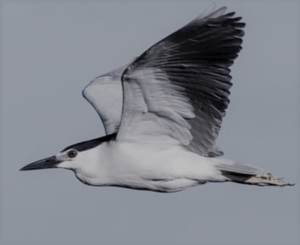 gravity. Determined.
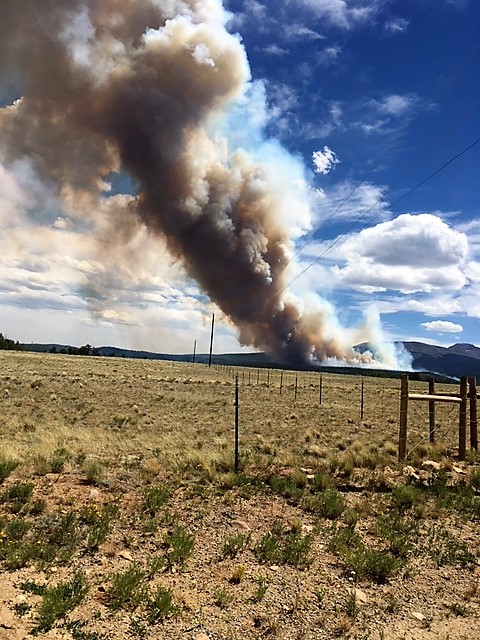 dropping mammoth buckets of liquid. Soon, hot air moves fast from the west, and the smoke darkens and reddens. I put down my binoculars and step out the back door, determined not to watch, not to worry. Nyx sniffs the air and refuses to walk with me, panting in the shade as a gust rattles dry aspen leaves. I go watch again: the smoke has become its own swirling black hillside as desiccated conifers combust. We throw our bags into the car and drive back to Denver.
 The More I Write